In Short
- Most Australian parents guess this wrong — an ADA survey found only around a quarter correctly picked age one or younger as the right time for a first dental visit.
- That first appointment is a short, gentle look-and-count, not treatment — the goal is familiarity, not a procedure.
- AIHW data shows decay climbs sharply with age: 34% of 5–6 year-olds have experienced it in their baby teeth, rising to 45% by age 7–8 and 46% by 9–10.
- Eligible children can access up to $1,158 in Child Dental Benefits Schedule (CDBS) funding over a two-year period starting in 2026 — we check eligibility directly, no separate application needed.
Ask ten parents when a child should first see a dentist, and most will guess somewhere between two and four years old.
The actual guidance says something much earlier.
That gap between what people assume and what dentists actually recommend is worth closing, because it changes how early problems get caught.
Most Parents Get This Wrong
In a survey of 25,000 Australian adults by the Australian Dental Association, 40% thought around age two was an acceptable time for a first dental visit, 20% said three, and 10% said four or older. Only about a quarter landed on the actual recommendation: age one or younger.
"Dentists recommend taking a child for their first dental visit when their first tooth comes through or by the age of one — whichever comes first," ADA President Dr Chris Sanzaro has said. That's not a soft suggestion — it's the actual clinical guidance, and it applies even when everything looks fine.
So Why Start That Early?
The case for starting early gets stronger the more you look at the data on untreated decay. The most recent national figures, from the 2012–14 National Child Oral Health Study, show 34% of Australian children aged 5–6 had already experienced decay in their baby teeth. That figure doesn't fall as children get older — it climbs to 45% by age 7–8 and 46% by 9–10.
Read that trend the way a dentist does, and it's not really about age — it's about how much runway there is to intervene before small decay becomes a bigger, more expensive problem. A first visit around age one gives several years of that runway before decay rates start climbing.
What Actually Happens at the First Appointment
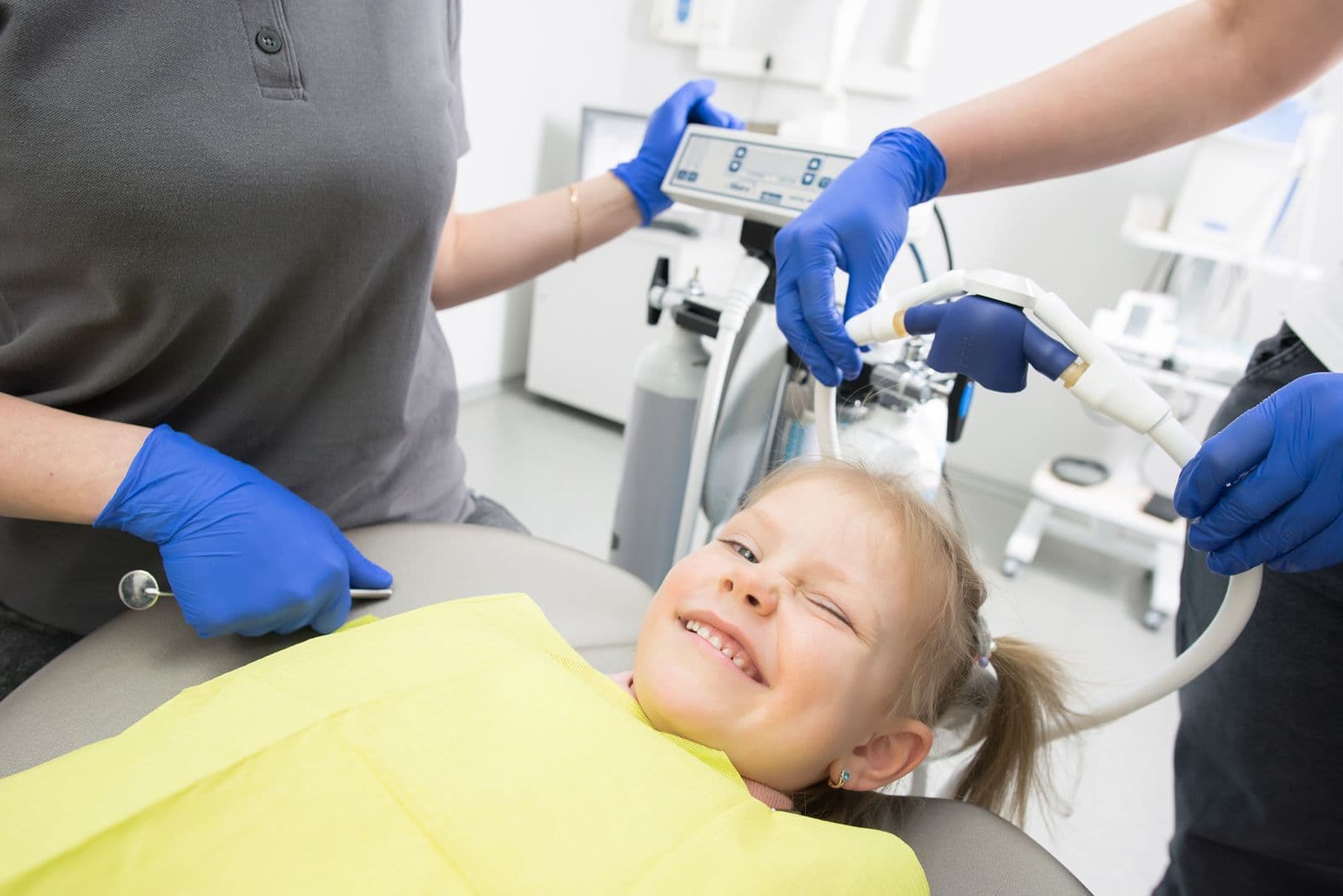
For an infant or toddler, this usually happens with your child sitting on your lap, facing the dentist rather than lying back in a chair. As part of our children's dentistry service, the dentist counts teeth, looks for early signs of decay or staining, and gets a rough sense of how the bite is developing — as much as is possible for a very young child.
Almost nothing is actually done at this visit beyond the examination itself. There's no drilling, no filling, often not even a proper clean. The entire point is exposure — teaching your child that this room, these sounds and this chair are nothing to brace for.
Getting Your Child Ready
The parent being relaxed about it matters more than any script you use with your child.
- Call it a visit to "count teeth" or "check your smile" rather than going into detail about what might happen
- Read a picture book about visiting the dentist together beforehand, or play-act a check-up with a favourite toy
- Book a time when your child is usually rested and fed, rather than squeezing it in around a nap or a meal
- Bring a comfort item — a blanket or small toy — if that helps your child settle in new places generally
- Write down anything you've been wondering about (teething, thumb-sucking, brushing battles) so you remember to ask

Daily Habits That Matter More Than Any Single Visit
What happens at home between appointments does more for your child's teeth than the appointments themselves.
- Cleaning starts the day the first tooth appears, using a soft, child-sized brush
- You'll need to do the brushing yourself, or supervise closely, until your child is around eight — that's roughly how long it takes to develop the coordination to do it properly alone
- Tap water between meals beats juice or cordial for every tooth in the mouth, not just the front ones
- Once two teeth sit side by side, usually sometime in the toddler years, it's time to start flossing between them daily
| Age | Toothpaste | Amount |
|---|---|---|
| Under 18 months | Water only, unless your dentist advises otherwise | — |
| 18 months – 6 years | Low-fluoride children's toothpaste (~500–550 ppm) | Pea-sized, twice daily |
| From 6 years | Standard adult-strength fluoride toothpaste (~1,000–1,500 ppm) | Pea-sized, twice daily |
Based on Australian Dental Association fluoride guidance. Your dentist may recommend a different concentration depending on decay risk and local water fluoridation.

Paying for It: The Child Dental Benefits Schedule
The Child Dental Benefits Schedule gives eligible children aged 0–17 access to up to $1,158 for basic dental services over a two-year period starting in 2026 (children partway through a period that started in 2025 remain on the earlier $1,132 cap for that cycle). It covers exams, cleans and fillings, but excludes cosmetic work, orthodontics and hospital treatment.
Eligibility depends on your child being covered by Medicare and you or another carer receiving a qualifying government payment, such as Family Tax Benefit Part A. You don't need to apply separately — bring your child's Medicare details and we'll check eligibility and remaining balance before any treatment. For anything the CDBS cap doesn't stretch to cover, our payment plans can help spread the rest.
We bulk bill CDBS-eligible children directly, with no waiting list — ask our front desk to check your child's eligibility before you book.
At Mount Druitt Dental Care
Ready for Their First Visit?
Gentle, unhurried appointments — CDBS eligibility checked before you book.
When a General Dentist Isn't the Right Fit
Most children are perfectly well cared for by a general dentist experienced with kids. A referral to a specialist paediatric dentist — someone with extra postgraduate training in treating infants, children and teenagers — becomes worth considering for extensive decay needing sedation, a developmental condition affecting the teeth or jaw, or anxiety a general dentist's usual approach can't manage.
Most children who start seeing a dentist young never need that level of care at all, simply because problems get caught early rather than left to grow into something bigger.
How We Do This at Mount Druitt Dental Care
Our waiting area has toys and a colouring-in space, and our team uses playful, age-appropriate language throughout — asking kids to "roar like a lion" so we can see their teeth is a genuine favourite. Children who do well leave with a small reward for being such great patients.
We generally recommend a check-up every six months from that first visit, adjusted if your child turns out to need closer monitoring. If we ever think a case is better suited to a specialist paediatric dentist, we'll say so and help arrange the referral rather than manage it ourselves regardless.
Please note: CDBS caps, eligibility rules and fluoride guidance can change. Figures in this article are correct as of September 2026 — always confirm current details with our team before booking.